Icons
 Travel photography
Family-friendly: true
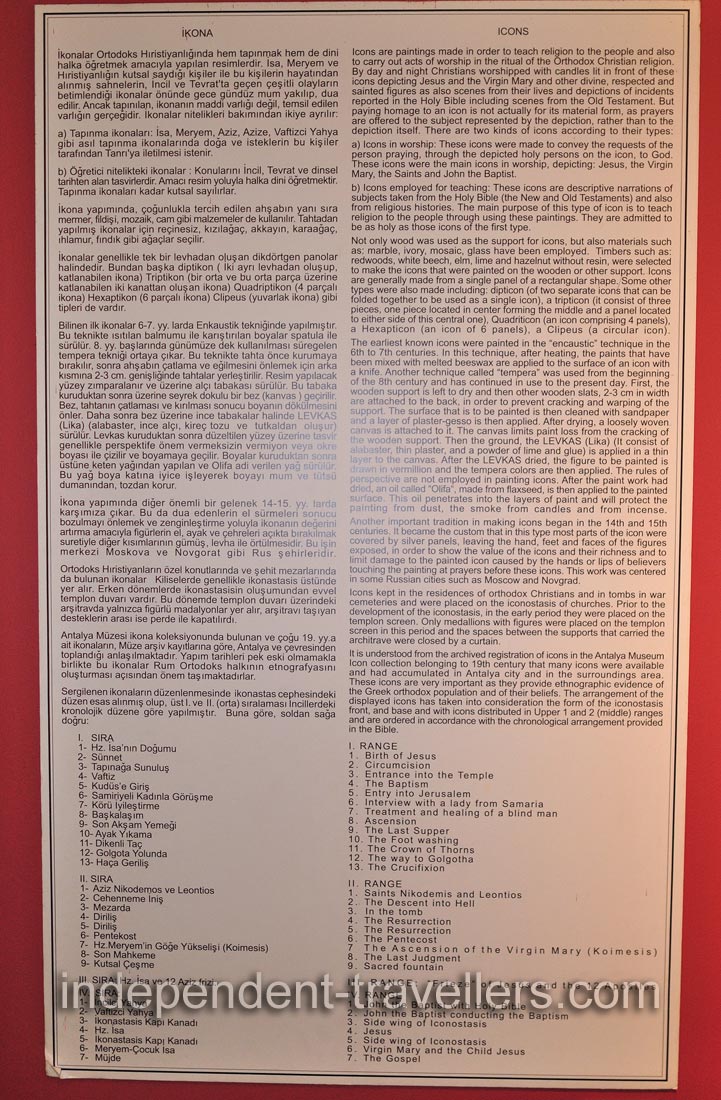
Icons are paintings made in order to teach religion to the people and also to carry out acts of worship in the ritual of the Orthodox Christian religion. By day and night Christians worshipped with candles lit in front of these icons depicting Jesus and the Virgin Mary and other divine, respected and sainted figures as also scenes from their lives and depictions of incidents reported in the Holy Bible including scenes from the Old Testament. But paying homage to an icon is not actually for its material form, as prayers are offered to the subject represented by the depiction, rather than to the depiction itself. There are two kinds of icons according to their types:
a) Icons in worship: These icons were made to convey the requests of the person praying, through the depicted holy persons on the icon, to God. These icons were the main icons in worship, depicting: Jesus, the Virgin Mary, the Saints and John the Baptist.
b) Icons employed for teaching: These icons are descriptive narrations of subjects taken from the Holy Bible (the New and Old Testaments) and also from religious histories. The main purpose of this type of icon is to teach religion to the people through using these paintings. They are admitted to be as holy as those icons of the first type.
Not only wood was used as the support for icons, but also materials such as: marble, ivory, mosaic, glass have been employed. Timbers such as: redwoods, white beech, elm, lime and hazelnut without resin, were selected to make the icons that were painted on the wooden or other support. Icons are generally made from a single panel of a rectangular shape. Some other types were also made including: dipticon (of two separate icons that can be folded together to be used as a single icon), a tripticon (it consists of three pieces, one piece located in center forming the middle and a panel located to either side of this central one), Quadriticon (an icon comprising 4 panels), a Hexapticon (an icon of 6 panels), a Clipeus (a circular icon).
Icons kept in the residences of orthodox Christians and in tombs in war cemeteries and were placed on the iconostasis of churches. Prior to the development of the iconostasis, in the early period they were placed on the templon screen. Only medallions with figures were placed on the templon screen in this period and the spaces between the supports that carried the architrave were closed by a curtain.
It is understood from the archived registration of icons in the Antalya Museum Icon collection belonging to the 19th century that many icons were available and had accumulated in Antalya city and in the surrounding area. These icons are very important as they provide ethnographic evidence of the Greek orthodox population and of their beliefs. The arrangement of the displayed icons has taken into consideration the form of the iconostasis front, and base and with icons distributed in Upper 1 and 2 (middle) ranges and are ordered in accordance with the chronological arrangement provided in the Bible.
I. RANGE
1. Birth of Jesus
2. Circumcision
3. Entrance into the Temple
4. The Baptism
5. Entry into Jerusalem
6. Interview with a lady from Samaria
7. Treatment and healing of a blind man
8. Ascension
9. The Last Supper
10. The Foot washing
11. The Crown of Thorns
12. The way to Golgotha
13. The Crucifixion
II. RANGE
1. Saints Nikodemis and Leontios
2. The Descent into Hell
3. In the tomb
4. The Resurrection
5. The Resurrection
6. The Pentecost
7. The Ascension of the Virgin Mary (Koimesis)
8. The Last Judgment
9. Sacred fountain
III. RANGE: "Frieze" of Jesus and the 12 Apostles
IV. RANGE
1. John the Baptist with Holy Bible
2. John the Baptist conducting the Baptism
3. Side wing of Iconostasis
4. Jesus
5. Side wing of Iconostasis
6. Virgin Mary and the Child Jesus
7. The Gospel